
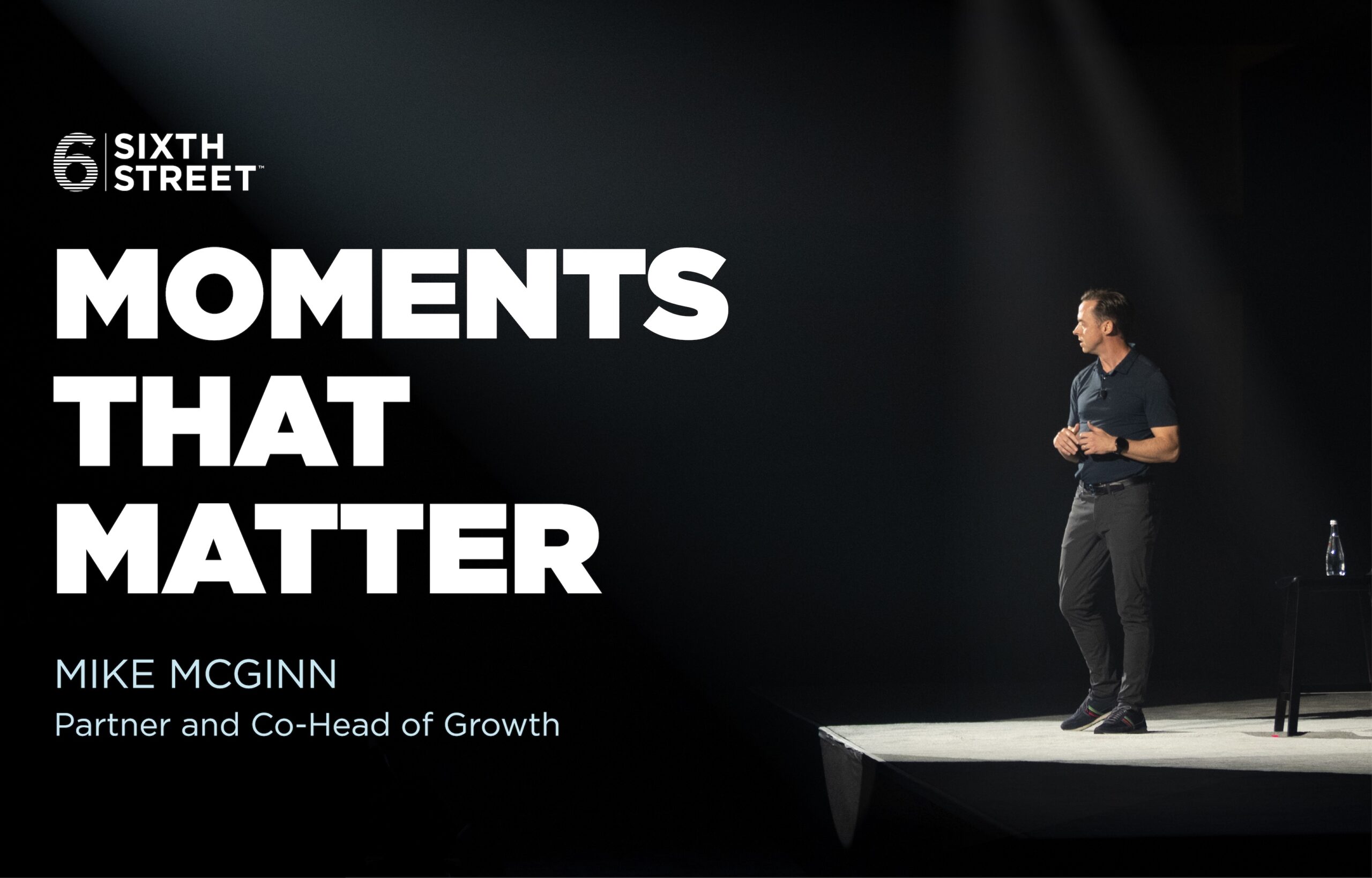
Sixth Street’s Mike McGinn on Constructive Feedback and High-Performance Leadership
In this episode of Moments That Matter, Sixth Street Partner and Co-Head of Growth Mike McGinn reflects on how his approach to feedback, accountability, and leadership has evolved. He shares why leaning into direct and empathetic feedback helps people and teams perform at their best.
Key Takeaway: Direct and honest feedback is the kindest thing a leader can do.
Episode Transcript:
There's so much talent. I want to start by acknowledging all that. This is a hard competitive industry, and we know that success in our field comes at a price.
You know, one of my mentors has told me that exactly. Success has a price.
We've all missed dinners, experiences, family time, in order to be in the seats that we're in today.
I've been thinking a lot about this recently, how we respect and honor the price that we've all paid for success.
And I've come to realize that one of the best ways we can do that is to be honest and clear with each other, especially when it comes to giving and receiving feedback.
So, if you're up for it, I'd like to share some hard won perspective that might help you avoid some of the mistakes that I've made regarding feedback and might help us all perform at an even higher level.
So, to start, I wanna take you back to my junior year of college, 2000, 2001. For those of you who literally weren't alive, let me help orient as to where the world was.
Michael Jordan was still playing basketball.
Brad Pitt and Jen Aniston just got married.
The very first Harry Potter movie took the world by storm and Blockbuster video passed on buying a budding little startup named Netflix.
Back on campus, I was busy preparing for summer internship interviews, and I was wearing these round rimmed eyeglasses at the time.
I did not grow up in the finance world. I had no angle or edge into the interviewing process.
And while the Notre Dame alumni network was really deep in Chicago, I wanted to be back on the East coast where the network was far less developed, so I prepped for these interviews like crazy.
I had a final round, on site, had an interview with a VP or MD and I thought it went well.
So right before I get up to leave and finish the interview, the guy says two things.
First, he says, you know, that question that you answered on valuation, you know, you could have been tighter there, you know, here's some guidance.
I'm like, you know, cool, helpful, good direct feedback.
And then he says, and I'll never forget it. And one more thing, ditch the glasses because the Harry Potter look isn't working for you.
Yeah, my college roommates thought it was funny too. And at the time, you know, I didn't, I literally thought, what an asshole.
The feedback wasn't helpful. It was punching down. It pissed me off.
I ended up getting an offer, turned it down. Obviously stayed in the industry, but I'll tell you what, like that comment stayed with me, but probably to a fault.
As I continued to advance in my career, I remember how the negative feedback felt, and as a result, I think I swung too far the other side when I started managing people.
I struggled to give constructive feedback because I didn't want to be that guy who made people feel the way that I felt in that room.
It's not that I wanted to be nice, but I know that I didn't want to be mean.
And so now I hope you can guess where this is going.
By avoiding constructive feedback, I wasn't being kind at all. In fact, it was the opposite.
I was denying those individuals who needed to hear constructive feedback, the opportunity to learn and grow.
In addition, I was putting an increased burden on the rest of the team because they had to carry extra weight.
And that's actually pretty mean, and not how you respect the work and sacrifice that we've all made to succeed in this field.
This can have investment consequences as well.
We had an investment in a company and the CEO of that portfolio company didn't hold his people accountable for deadlines nor product deliveries, because, and he told us he wanted to be liked by the team.
Unfortunately, by the time we figured this out and learned it, it was too late to recover all of our investors' capital.
And so, if I were to pull back and identify a trait that most or all ineffective leaders or CEOs have is that they're reluctant to hear and disseminate tough feedback across the organization.
However, we try to learn from our mistakes. And when we saw another CEO exhibit, the same tendencies as his operating environment intensified, we took prompt action, faced the tiger, and had direct but respectful conversations with the CEO and the board.
We catalyzed substantial changes to the business, including moving on from that CEO and hiring a new one.
That is likely not only to the result and the return of our capital, but hopefully a return on our investment as well.
Having been through a number of review cycles and working through that CEO transition, we realized that being direct and honest is actually the kind thing to do.
Let me relay a piece of advice that I've got to help take the edge off of some of these feedback conversations.
Pressure test at the feedback that's given, maps to somebody's personal business plan.
We have our firm wide five-year business plan.
Hopefully that's not news to anybody, which is basically a summation of our bu specific five year business plans, which is effectively a summation of all of our team personal business plans.
Are we all giving and getting the feedback both good and constructive, that we need to hit our personal business plans, so that we can hit our BU business plan, so that we can hit the firm's five-year plan.
I want to hit on another point that I had to learn and experience. When we receive feedback, we have an obligation to hear it, internalize it, and ensure that there's common understanding on key points.
We can't just hear what we want to hear.
What do I mean? An anecdote from being on the receiving end.
I had a feedback session with Alan and Julian, talked about a number of things, and five minutes after it wrapped, Alan actually called me back and reinforced a few of the key points and the light, you know, slow, the light bulb went off for me.
He didn't think I heard what he had said, and he was right.
So a tip I picked up was to play it back. And so I literally say to him, Hey, I want to play back what I heard and make sure that we're a hundred percent synced.
We did that, locked arms and moved forward.
And so we had our CEO event last month. That builds a lot of stress units for me.
There's a presentation that goes with that. We go through the presentation, wrap the mash summit, fly back home and go through the pain of rewatching my presentation, on TV at home.
And, as I'm doing that, my high school, I have a freshman in high school, he walks into the room and he says, dad, you know, you're talking a little fast.
Maybe, we wanna slow down a little bit.
I'm like, thanks Jack. That's helpful.
Fourth grade son barges into the room, looks up at the screen, he's like, dad, your forehead looks huge.
Like sweet. Thank you. It's like, some things never changed.
So, let's, let’s play these last few minutes back.
The Harry Potter comment was personal, which is what made it mean.
Direct and constructive feedback is integral for professional growth and is actually the kind thing to do.
We don't have to absorb the toxic parts of the industry, but we can't use being nice as an excuse to avoid being great leaders and excellent colleagues.
So, give the feedback today or in the upcoming review cycle.
Hear the feedback when giving the feedback, do so with empathy and do it because you want the person to win and get better.
Finally, you know, the goal that we're all trying to build here is a culture where we leave the unnecessary sharpness at the door but never leave the honest truth behind.
Thanks everybody.