
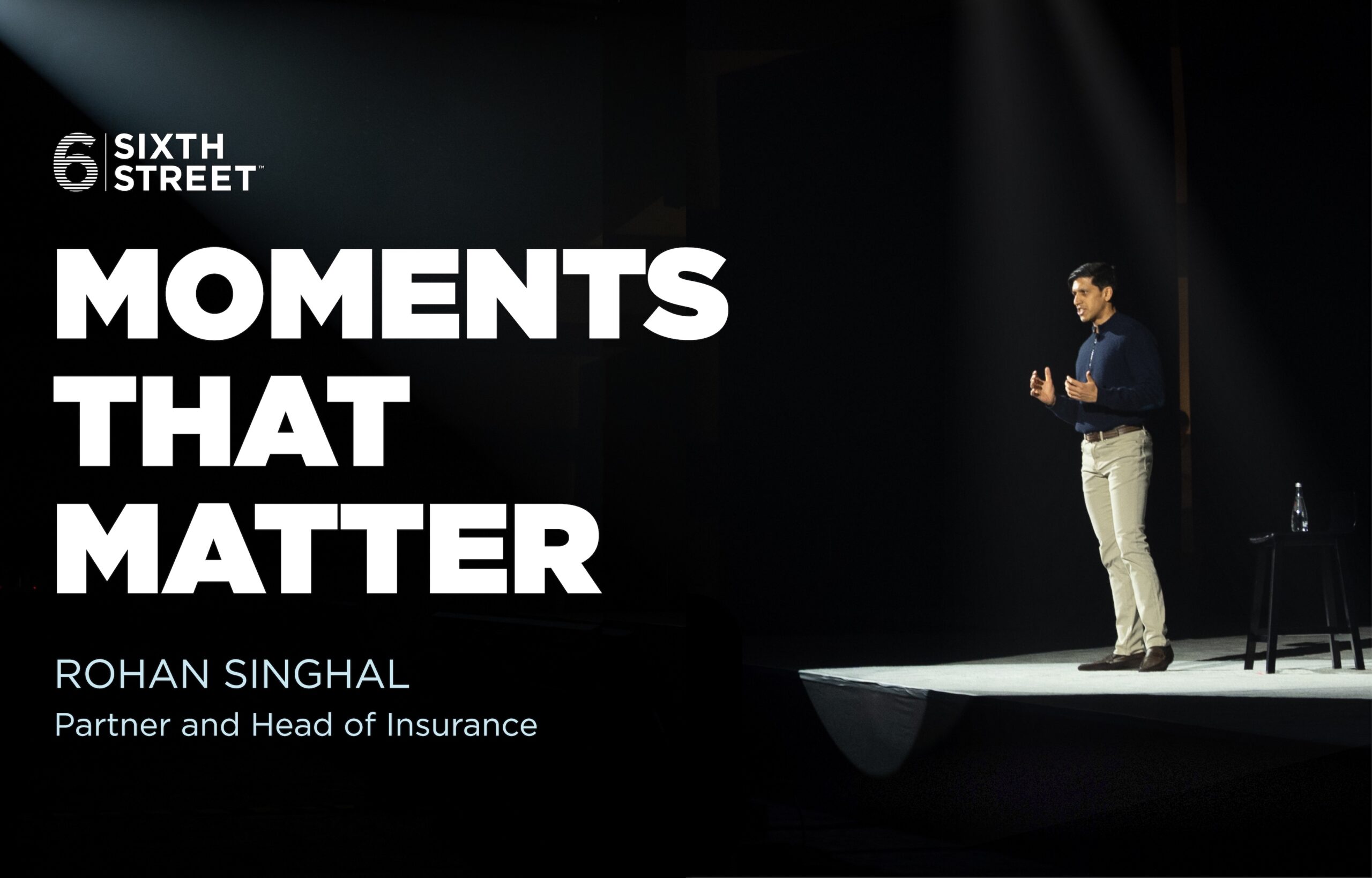
Sixth Street’s Rohan Singhal on Choosing Conviction Over Comfort
In this episode of Moments That Matter, Sixth Street Partner and Head of Insurance Rohan Singhal reflects on an early-career decision that taught him to prioritize conviction over comfort. He shares practical guidance for evaluating difficult choices, testing assumptions, and staying true to long-term values.
Key Takeaway: Slow down to evaluate difficult decisions with greater clarity. Recognize that small, daily choices compound over time.
Episode Transcript:
Good afternoon, everyone. My name is Rohan Singhal, and today I want to talk to you about probably the most pivotal moment and decision of my professional life to date.
So, in 2012, a very cool work opportunity came knocking at my door. A former boss of mine from Goldman Sachs asked me to join him at a startup.
We were going to set up a real estate fund seeded by a global luxury retailer, and our task was simple. We'd go out there and acquire real estate all around the world in locations where the brands wanted to expand.
These were generally secondary cities where these brands were not already present.
You know, where should the next Cartier, Van Cleef, Dunhill, Mont Blanc, where do they want to open their stores next?
And the idea was we wouldn't just buy the retail plot, but we'd buy all the real estate surrounding it.
So, the residential, the hotel, the office space. And the idea was the entry of these brands would gentrify the entire micro location.
The investment thesis made perfect sense, and we knew it was going to be a lot of fun. And it was.
We made three large investments, one in Paris, one in Seoul, in South Korea, and one in Saadiyat Island in Abu Dhabi, where a number of us actually were earlier this year.
Everything was going great.
That is, of course, until the retailer itself had a leadership change. And the first ask the new CEO had of us was, can we give a rental break to the retail brands to give them an advantage over the other tenants from competing retailers on the same plots?
Now, he knew that was going to break our entire business model. And so, he tried to sweeten the deal. He came to us with a proposition, leave the entire idea of having a separate real estate fund, come in-house into the retailer and join the executive team.
We'd be based in Geneva, but we could keep our places in London. We'd have a pretty cushy life, a very predictable schedule. And I could keep doing what I enjoyed most of the time, which was being a real estate investor. It was going to be a comfortable life.
And there's absolutely no doubt in my mind that that would've been the easy decision, way less friction. But something didn't quite feel right.
And even though I was very early in my professional career, I knew back then that I needed to be surrounded by like-minded, super ambitious people from whom I could learn every day. Was I really going to get this if I stayed where I was?
On the other hand, by far, the easiest option was to maintain the status quo. Why not give it a go for a year or two? Maybe things change. What's the real downside? Am I really going to ever get another opportunity like this again, especially at my age.
So, after many hours and frankly months of debate, I finally decided to move on.
And let me tell you, that was a deeply humbling moment, because I saw that as my first real professional setback.
This grand vision we had for our own startup was dead. No one would care why or whose fault it was. But just 12 months after what felt like a very promising role, the dream of our own startup was truly dead.
But what I now know with the clarity that always comes with hindsight is this, whenever in doubt, personally or professionally, prioritize your convictions over comfort. And that often, possibly always, means making the harder, less comfortable decision.
And I definitely didn't see it in that scary moment. But that decision is what led me to Sixth Street, which had defined me in so many ways personally and professionally over the last 13 years.
And even today, when faced with tough decisions, I remind myself at this exact time in my career and try and follow some simple rules.
The first may seem very obvious, but slow down, which sometimes feels like an insane thing to do in our, especially in our line of work. And that's exactly why it's my first piece of advice. It is the uncomfortable choice.
In our jobs, we all run at a million miles per hour. That's the pressure we thrive under tells us to do, which is why slowing down can feel so uncomfortable, but absolutely essential to do so, to take a breath, to properly evaluate the options in front of you.
And then second, that's the moment you can really start playing tennis with yourself. Bounce it around your head to evaluate the options. Take the opposite side and really evaluate.
Sit with the idea that the, the decision your heart and brain may want to take may actually be the wrong one.
I often follow a simple rule, which is whatever may seem like the harder choice, assume that's the right decision, and then try and argue against it. How compelling are those arguments really? Do I look like Dr. Jekyll and Mr. Hyde sitting in my office weighing every aspect? You bet I do. But let me tell you, this works, and I still follow these rules today.
More recently, about five years ago, we actually had an opportunity, a massive opportunity to transform the insurance business within Sixth Street through a transformational merger.
Financially, this would've been an absolute no brainer, especially for the GP. But we thought it was a great deal for our investors too.
But something didn't quite feel right. Were we truly culturally aligned with our partner? When things would go wrong, which they inevitably would, would we stay aligned with them? Was there really that trust between us that we could, we could rely on?
Without a doubt, the easiest, and by far, the most financially lucrative decision would've been to go ahead with the, with the decision.
And more than once, I asked myself the same question, would we ever get another opportunity like this? This felt like a generational moment.
But ultimately, keeping our north star of always prioritizing the convictions over comfort and doing the right things for our investors, we passed on the opportunity.
And looking back on that moment today was absolutely 100% the right decision.
My final piece of advice is that sometimes it's not always the big threshold moments that really end up mattering.
Rather, all of those micro decisions you evaluate and make every single day. They add up and multiply over a career, and honestly, a lifetime, especially to the negative.
And it's that ability to push yourself and apply your conviction over comfort test on the three to five micro decisions you face every day. That has, for me at least, have a huge impact on where I am today. Mostly to the positive, but certainly not exclusively.
By micro decisions, I mean those 32 second action items that are so easy to discard.
You know, like dropping a quick note to acknowledge someone's efforts and grabbing a teammate after a meeting to give them feedback or guidance, or taking a breath to ask that extra question when the easy answer would be to simply approve a request.
On a busy, super packed day, it's so easy to choose inaction over action, especially on seemingly less material matters.
But when those micro decisions get made, especially if they're annoying or require that extra bit of thought, they add up, multiply and drive how you spend your time, who you spend your time with, and fundamentally who you as an individual become.
So, the next time you're faced with a decision, make this move or that move. Take this job or that job. Make this leap or stay put.
Think long and hard about the tough choice. It's probably the right one.
Thank you very much.