
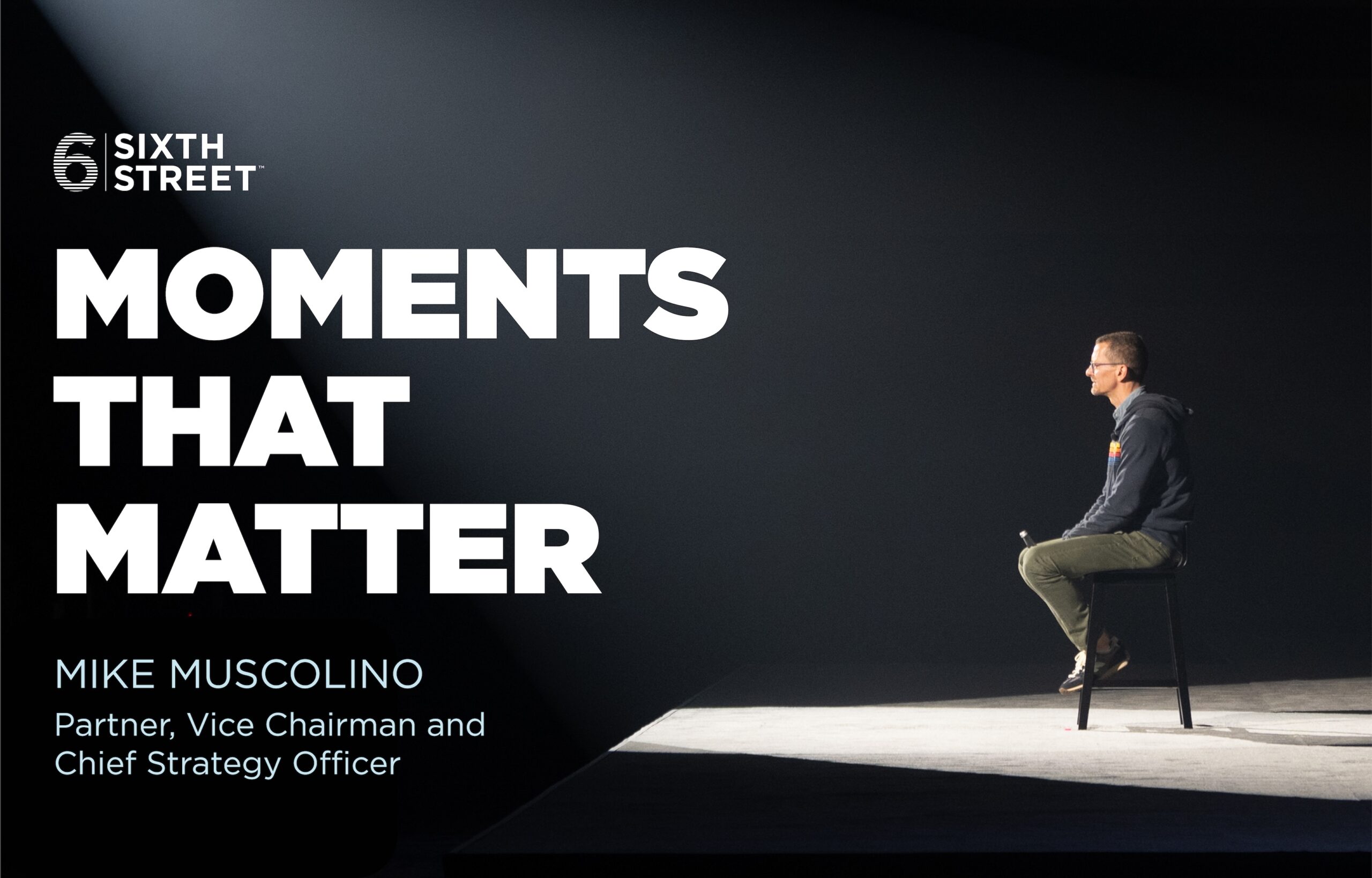
Sixth Street’s Mike Muscolino on Leading in the Gray
In this episode of Moments That Matter, Sixth Street Vice Chairman and Chief Strategy Officer Mike Muscolino reflects on why high standards are most effective when paired with self-awareness, patience, and a commitment to developing others.
Key Takeaway: Effective leadership lives in the gray, where high expectations are balanced with nuance, empathy, and development.
Episode Transcript:
Hey everybody, I'm Mike.
So, I'm going to date myself a little. I'm going to start by taking you back to 2003.
I'm a young Vice president Goldman Sachs, and I'm leading a deal on this intense bankruptcy project. One of the largest corporate bankruptcies in US history at the time.
We've been working for months leading up to the 360 3 auction, preparing to bid on the finance subsidiaries of the parent.
This culminates at the lawyer's offices in Chicago, attempting to position ourselves as a stalking horse bidder.
Discussions run all night and into the next morning.
I'm running between rooms, negotiating, arguing, yelling at lawyers, bankers, creditors, everyone that'll listen.
I won't bore you the details, but we were able to structure creative backstop dip to facilitate the orderly liquidation as an alternative to 360 3 sale.
The firm earns a massive commitment fee without ever funding a dime. It's a big win for me and a pivotal point in my career.
What I took away from that whole experience is that if I could outwork everybody, if I could outthink everybody, out grind everybody, I could make a lot of money for the firm.
I got a reputation as a guy who could get things done, and that really set me on a path for the next few years of continued professional success.
The playbook seemed so obvious to me. I thought I had it all figured out.
In hindsight I was just emulating the behaviors I observed in successful people around me.
They were all trying to outwork and outsmart everyone around them, and if you did something wrong, they'd tell you.
So that's how I worked in Manage two.
But then I hit my first professional speedboat, and this is actually my moment that matters.
You know, at Goldman we need 360-degree reviews, and the recognition I consistently got from the people above me was positive.
But the commentary from junior people, increasingly, not so much.
Frankly, I got crushed by their feedback. Junior people really didn't like working for me.
It was hard to process. It didn't make sense at the time.
You know, I wasn't asking anyone to work outside the norms of the institution or work any harder than I did, and I felt like I was just giving people direct feedback.
Asking them to hold the firm and themselves to a high standard, the same as I did.
If someone screwed up, I’d tell them they did something wrong and I’d tell them not to do it again. It was simple.
My approach seemed so straightforward, so I wasn't sure why people were so unhappy working for me.
The answer took me some time to understand. So let me save you the trouble and tell you what I think I know now.
Things aren't as simple as black and white, or right and wrong.
Success and teamwork is really measured in the gray and my drive for success, my drive to work harder, work smarter, and my drive to be direct, I left no real room for constructive growth, for nuance or learning, and it took me time to process that.
So, today I want to share with you some of the ways I've learned to lean into the gray, because I've come to believe the gray area is where success really lives and thrives.
So, the sooner we can all move away from our black and white tendencies, the more successful we can be.
So, I got three things for you. First, you can't improve as a person or as a leader if you're not aware of your strengths and weaknesses in the first place and that’s probably obvious. Self-awareness is important.
I think a lot of us have a desire to grow and change, but it is hard. Your black and white tendencies will constrain you.
You know, it's easy to reflect on the things you want to work on in times of quiet and low stress.
The pressure gets high; the temperature comes up. That's when we revert to our baseline tendencies.
That's when what I call in the moment, self-awareness really matters.
Can you see what's going on right here, right now? And course correct.
You know, a few yeasrs ago in an especially heated moment, Alan looked across the table at me, paused and said, breathe.
Seething, I looked back at him and responded, I am breathing.
It's factually accurate.
Black and white, yes. Especially self-aware, not so much.
You know, Alan was telling me to take a beat and recognize my temperature was rising. I wasn't in the gray.
The key to success in moments of high stress is to take a step back and understand where you're living.
Here's something to make you self-aware, really quickly. Mentor someone. Observe their behaviors in the moment and provide feedback.
There's something about observing others' behaviors through that lens that will draw your attention to your own black and white tendencies very quickly.
And if you do this right, you'll bring yourself and your mentee into the gray faster.
Alright, number two.
One of the biggest aha moments from those 360-degree reviews was that people were not hearing what I thought I was saying.
What I was saying wasn't being processed as I intended, and that's because I was communicating ineffectively to black and white.
We all tend to see the world through our own lens processing feedback differently.
While I may be a person who thrives on direct feedback, other people might prefer different style.
Telling someone they screwed up and not to do it again, isn't constructive and honestly can be super demotivating. It's black and white.
The gray approach to feedback's different. You don't give feedback like it's something you hand down on high. You guide the feedback.
Which means instead of just giving someone the answer, you have to have the patience to say, Hey, how would you have done this differently? It's a conversation. It's playing tennis. You hit ideas back and forth till you get the right answer. That's how it works with guided feedback.
You share, you reflect, you have a real conversation, and you let the other person build their own framework for correction and improvement, and that puts you squarely in the gray.
Alright, number three.
You're going to be in plenty of difficult situations and stressful moments when the thought's going to cross your mind to just do the work yourself.
You know you can do it faster, quicker, more efficiently in the moment.
But my strong advice to you is don't. Because if you keep doing everything yourself, you're not teaching those around you.
And that's bad for them, obviously, but it also limits you. And that quick fix mentality that urges you to solve is black and white.
So instead, just push forward and lean into the gray and allow for growth. Pass the baton.
The people around you will make mistakes. It will drive you crazy.
But good leaders create the safety nets and tools that make those mistakes small ones, not big ones.
Let me share some early career advice I got. Do your job well, then do your boss's job well.
Now I've reflected on that. I've amended that though over the years.
Success in the gray means you do everything you can to develop people who will eventually take your job and do it better than you.
Alright, so let's bring it together. At the end of the day, at the end of our long and hopefully successful careers, I've become convinced we shouldn't be measured by the success of the individual deals we've done, how hard we worked, or how much money we made.
You know, the stuff that exists in the black and white.
Ultimately, we should be judged by the quality of the team we built around us. How we hired, mentored, trained, and cared about other people's growth.
Developing the tools to accomplish that outcome is paramount to career success.
That's the gray. The nuanced, complex, and patient care that leads to success for everyone.
Thank you.