
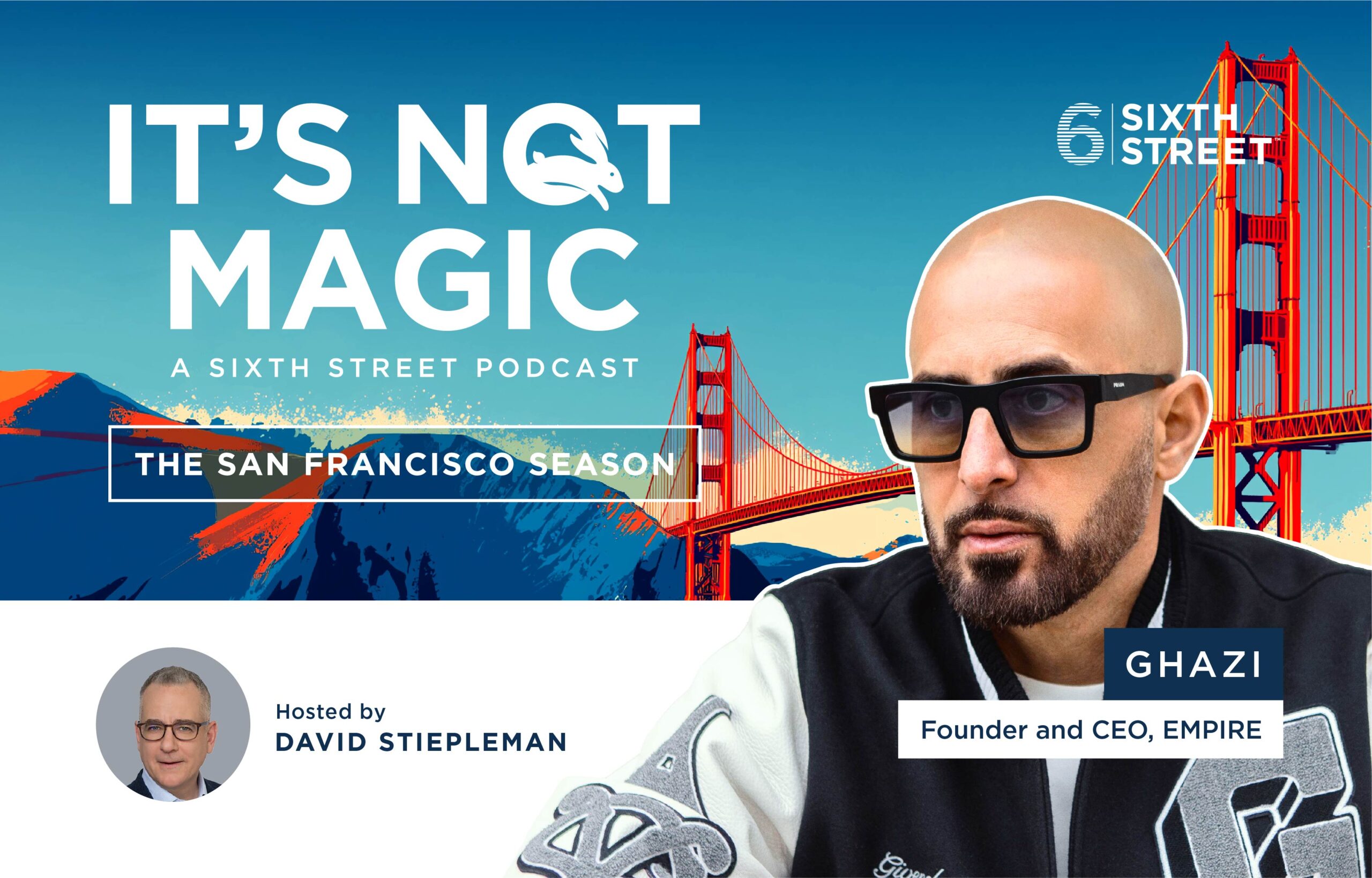
A Conversation with Ghazi, Founder & CEO of EMPIRE
Episode three of It’s Not Magic’s San Francisco Season features Ghazi, Founder and CEO of EMPIRE and Bay Area native. EMPIRE was founded and built in San Francisco and is now the largest independent record label, distributor, and publisher in the United States, working with artists including Kendrick Lamar, Anderson .Paak, and Shaboozey. Since launching EMPIRE in 2010, Ghazi has built a global powerhouse, known for its innovation, artist-first approach to partnership, and cultural impact that extends far beyond the Bay.
Recorded at Sixth Street’s San Francisco headquarters, Sixth Street Co-President David Stiepleman and Ghazi dive into the city’s legacy of technological innovation and entrepreneurship, how Ghazi’s own technical expertise and creativity were foundational to building EMPIRE and the role culture is playing in San Francisco’s renewal.
Ghazi underscores just how important it was for him to build his dream in the city where he grew up, asking, “Why do I have to go somewhere else to do something I’m good at?” With the label’s recent acquisition of the historic One Montgomery Street, Ghazi shares his plans to build EMPIRE’s new headquarters in San Francisco’s financial district and inspire the next wave of energy in the city.
Thank you to Ghazi for joining us for this inspiring conversation.
Listen to full episode:
Listen On:


More from this episode:
- San Francisco Examiner: Ghazi Shami’s Empire just getting started in SF
- Numéro: Why is Empire one of today’s most popular rap labels?
- San Francisco Chronicle: S.F. record label proposes rooftop concert venue at new downtown HQ
- San Francisco Business Times: Record label CEO Ghazi Shami talks AI, leadership and global expansion
- Billboard: The Bay’s All-Star: How EMPIRE’s Ghazi Brought the Music Business to San Francisco
- Brand Innovators: Local brands join San Francisco revitalization
Episode Transcript:
Ghazi: Being in San Francisco and working in Silicon Valley at that time period and having that juxtaposition of the grit, the culture, and the fast nature of the city along with the entrepreneurship and the progressive nature of Silicon Valley when it came to technology and kind of bridging that together. It was kind of the perfect underpinnings for me to birth myself as a creative executive, I guess I'll call myself.
Ghazi: I just think when you treat an artist like a partner, you get a completely different energy outta them. So, to the best of my ability, I always say, we're business partners. Your job is to bring the creative. My job is to magnify it.
Ghazi: Why do I have to go somewhere else to do something that I'm good at? You know, I want to make records in the Tenderloin, not in Hollywood. Right? And how do I make it so that what I'm making back home, it doesn't have to be as big or as grand or as impactful as LA, but how do I be an impact in my own community? So that the next person that's an engineer or a producer or a creative doesn't have to leave just to find an opportunity to make money with their craft. I just had an aggressive feeling in my body that I had to go back home and figure out how to do it on my own terms.
David Stiepleman: This is Ghazi, he's the Founder and CEO of EMPIRE Records, which is the global record label distribution publishing company. You guys are definitely living up to your name, 250 employees across six continents. And we've got cool guests on this podcast. We cannot overstate your global reach and influence. Kendrick Lamar, Cardi B, Anderson .Paak, Shaboozey. You guys have worked with these artists. You know, multi-platinum, Grammy winning artists. And every time I talk to you, you're in Vietnam or Cambodia or France or Japan or Nigeria or Korea, developing artists all around the world, which is really cool. And the people should understand, the so-called majors, the major labels, they're like “Oh, crap.” We better catch up and do what EMPIRE'S doing. And that's incredible. In terms of the streaming and the global reach and the true partnership that you have with artists, that's the way business is being done now. And you guys pioneered this and you started, kinda like us, 15 years ago, which is pretty cool. You're a combination of technologist, you're a record producer, you're an audio engineer, an entrepreneur. You're one of our city's great citizens, which, you know, I don't know if it's a new role, but it's kind of a new role, right?
Ghazi: Yeah.
David Stiepleman: Just being like a city father or whatever you want to call it. You're, like, the hardest working guy in show business and so to have you here, we are very, very grateful. So please welcome Ghazi from EMPIRE.
Ghazi: Thank you.
David Stiepleman: After you get applause, I'm tempted to just be like, we're done. We did a good job. But we should actually have a conversation, which I'm really looking forward to. Let's start with the music because it's all starts with the music. Can you take me to a moment, you're growing up here in San Francisco, where you were like, oh my God, I have to do that with my life. Was there a moment like that or was that too glib?
Ghazi: There were probably several moments like that.
David Stiepleman: Okay.
Ghazi: It was quite a few moments like that, but I think one that pokes out in my mind is I was working as a barback and a really popular San Francisco rapper walked in at the time, this is in the early 90’s, and his name's Black C and he's really famous because he always wore a patch over his eye. So, he walks in and he orders a drink from me. And I was like, “That's Black C.” And in that moment, you realize this guy grew up less than 10 minutes from where I was born, or less than a mile away. It felt very accessible. Everything felt possible. The proximity of everything made it feel very real, if that makes sense, that proximity was something that invigorated me. And so fast forward 30 years after that, I've been distributing his music for 16 years now. He gets a royalty check for me every month, 16, 17 years in a row. And we have a great relationship. So, one of those full circle moments that sticks out in my mind. Not something that I talk about a lot, but me and him have a great relationship.
David Stiepleman: I want to talk about how you do all the things that you're doing, but just zero in on the moment where you're hearing somebody for the first time or you're meeting an artist for the first time. Is it an instinctive moment where you're like, oh, we have to work with that person, or what is that moment?
Ghazi: It's definitely instinctive. I mean, I started making music when I was 14 and I started rapidly consuming it when I was six, and so there's certain things that you can't explain about a person's aura. It's an energy thing that resonates with you and you just say, I've seen this before. I've felt this before, and I know exactly what this means and how this is gonna transpose into the real world and how people are gonna connect to it. You're not always right. It's the same as somebody trying to pick an athlete for the NFL, like a scout. You just are right more often than you're wrong. How often do you pick right? I think our track record as a company shows that we pick right pretty often. I frequently sit with people that are loaded with bags of cash that just invest in artists aimlessly. And you know, I sometimes feel bad telling them you're putting your money in the wrong place. I'm not one to judge another person's decisions. I just know that when I feel something and something resonates with me, I usually just go for it.
David Stiepleman: Is there a common theme of what resonates?
Ghazi: It could be a number of different things, and it's usually when a number of different things triangulate and come together. It's somebody's vibe, it's the way they can walk or control the room, how people gravitate towards them. All these things are intrinsic values that are outside of, are they actually a good musician? Because there's a lot of people who are excellent musicians and can make excellent music, but are not necessarily stars. When you've been around it a lot, you can kind of see this person lights up the room a certain way that other people can't. Even Shaboozey super early on, I remember the first time,
David Stiepleman: By the way, I can get that song out of my head. It's been 15 months or whatever. But yeah. Congratulations.
Ghazi: He has another record that just went number one at Country Radio, so it was awesome. A record called Good News. But the first moment I met him, he had a certain charisma and charm about him that was unexplainable. He's really a student of country music. You know, you sit with him and there's nothing artificial about what he's doing. It's through and through something that he's very passionate about and that oozes out of him. It’s not something you can actually explain. It's something that you have to experience.
David Stiepleman: What's a little bit hard for me to understand, is how you do that in region, country, continent after continent, country after country. And you're having similar success all over the world. And you and I have talked about a little bit, when you land somewhere, you're not just like, oh, where am I? You've done a lot of work. What, what is, what does that work look like?
Ghazi: There's different things that you look at. It depends on if you're looking at it through an artistic lens, a business lens, a culture lens. Before I go somewhere, I'm looking at, from a cultural lens, I'm looking at the music, what's resonating genre wise. What are the fashion trends? What are the music consumption trends from an A&R standpoint? Is there a specific artist that's buzzing that has something going on that would bring me to this market to try to sign this particular artist? From a business lens, you're looking at it and you're saying, what is the monetization roadmap of all the subscription services? What is the exchange rate on currency? What is the geopolitical nature of this country's currency going up or down? There's a lot of different things you look at from a finance position, things that would clearly resonate with your company. And then you kind of try to play four-dimensional chess, right? You're looking at all these things and you're looking at the intersection of all these different mediums and you're saying, how does this country look on my roadmap or this region? Or this language? Is there a diaspora language? Does it connect to other countries? Is there a diaspora migration? So, then you look at Vietnam, for example, and you say they're very early in monetization. Culture is exploding. But there's large diasporas in San Jose, Los Angeles, Houston, right? Paris, Australia. These are well-monetized markets with buying power. Can we build these particular artists through touring into those markets? So, there's a lot that goes into it. And then is the music good? Obviously. Before I go to a country, I'll Wikipedia the whole country and understand, what is the religious composition of the country? What are the tipping behaviors? What kind of music are they listening to? What's maybe some of the cultural fluency of that country when you go to Vietnam? The north is a lot different than the south. Are you visiting Hanoi or are you visiting Ho Chi Minh? There's just a lot that goes into it. I'm just a very curious person, so I always want to just walk in with a certain set of knowledge that pays a certain level of respect to the place that I'm visiting.
David Stiepleman: Let's rewind the tape, 15, 20 years, whatever, you're thinking about what EMPIRE'S gonna look like and preparing it for this moment. This is not a mistake. I mean, you've been thinking about this and building it this way and maybe go back to, you were streaming before there were streaming. How did you know how to do that? Talk about your background as a technologist and sort of what you were thinking.
Ghazi: I mean, I started making records when I was 14 and then somewhere along the way, obviously, the internet launched.
David Stiepleman: Were you a musician as a kid?
Ghazi: Yeah.
Davied Stiepleman: What did you play?
Ghazi: I didn't play a traditional instrument. I programmed drum machines and flipped samples.
David Stiepleman: Got it.
Ghazi: And so much like people are experiencing now with, with the acceleration of AI and saying, that's not real or that's not a real musician, my parents looked at me and said the same thing. “Oh, you're programming a drum machine that's not a real drum set.” Or, “You're chopping a sample from a seventies record. You don't know how to play an instrument.” But when you chop a sample from a 70’s record, you filter it, replay a bass line under it, reprogram all the drums, and then lay lyrics and melodies on top of it. You're for sure a musician. I know many people that can play concertos that can't do that, right? So, it's just a different type of musician. It took a long time for that to be accepted into the mainstream. When I first started making music, I was making rap records as a freshman in high school, and at that time period, everybody said rap was a trend that would burn out in a few years. And now, many years later, without rap, I don't exist as an executive. That was the thing that gave me a pulse and, and made my heart beat and my blood pump a certain way that inspired me to be an executive and to be a creative. And so somewhere along the way, technology started to explode. The internet started to explode. And living in San Francisco, you're kind of living in the middle of it. There was a company in the Novato area called Sonic Solutions. Sonic Solutions was one of the first companies to build what we now know as digital audio workstations, DAS. And then from that spawned digital design, which was in Palo Alto, which is now Avid. It was in Menlo Park actually. And they built Pro Tools, which is by defacto standard, the biggest, most prominent recording software in the world. And then obviously, Logic and all the other things were like offshoots of that. But being in the middle of that and watching all that, and then simultaneously working at a computer company. I was running the assembly line at a computer company building like 10,000 PCs a month. I would take leftover computer parts and build my own systems and run really early versions of software like Cool Edit Pro and record like 16 tracks on a computer when most people were still on two-inch tape. And I would argue with my teachers about recording on computers, because they would say hard drives will never be fast enough. There will never be enough RAM. The bandwidth will never work. And I was like, I'm doing it right now. What are you talking about? By my senior year at San Francisco State, the system that I had cobbled together three years prior at my studio, they were using the same system in the studio. I walked into my final and just popped in a floppy disc and hit enter. And he pulled up my whole mix, and I walked out with an A. And so it was, you know, being in San Francisco and working in Silicon Valley at that time period and having that juxtaposition of the grit, the culture, and the fast nature of the city along with the entrepreneurship and the progressive nature of Silicon Valley when it came to technology and kind of bridging that together was kind of the perfect underpinnings for me to birth myself as a creative executive, I guess I'll call myself.
David Stiepleman: Do you remember the moment where you're like, okay, I'm gonna go do this by myself. Was that scary?
Ghazi: There were multiple moments. The first moment was when I left Sun Microsystems was going through consolidations, and that was my last tech job. I was probably, I don't know, 23, 24. I got a call from the HR department and he said. So, I used to work at Sun from nine to five. I'd go to the Santa Clara campus, and I was working for the CEO staff as a data technician setting up video conferencing systems and laying ethernet in buildings like this. And I was on the freeway headed to my studio, which was in the Tenderloin at Hyde and Eddie, which is still there. That's Hyde Street Studios, which is, I've been asking Mayor Lurie to landmark the building, because that's where the Grateful Dead recorded, Tupac recorded 2Pacalypse there. I recorded Game’s first album before he was signed to Interscope. There was just a lot of legendary stuff happened in that building. George Clinton used to just wander the hallways in the middle of the night. It was crazy. But you had this interesting like dichotomy of me working for these like billionaire Silicon Valley guys and I would be dressed like you and then I would jump in the car and switch into a jersey and Air Force Ones and drive to the city and work at the studio till two or three in the morning.
David Stiepleman: That was my other outfit by the way.
Ghazi: Yeah. I'm gonna get you a Mitchell & Ness throwback. I got you for Super Bowl. So, I'm on the freeway one day and I got a call and it was like, you can jump to another department or take a severance check. I had no idea what severance meant, but I was on the phone, and I said severance And, it was flip phones. I hung up the flip phone. I remember because you clam shell it shut. And I looked right into the sun driving north from Redwood City. And I said, “What the hell did I just do?” I think I got like a $6,000 check. And it was enough to pay for my studio for about three more months. And then I just never looked back. I just stayed in the studio every day until I made enough money to never have to look back. It was a long climb though. 24 to 32 was a struggle.
David Stiepleman: What comes to mind?
Ghazi: A financial struggle. It was just hard because you eat what you kill and you're a lone wolf. People are trying to nickel and dime you because you're an entrepreneur. So, there was a lot of chaos in my life, a lot of death. I was running in really rough circles, making the kind of music I was making and building the network that I was building. It was just rough. I think it was rough. And then at 31 or so, I took a consultancy job at INgrooves, which was one of the pioneering companies for digital music here in the Bay Area. They were a digital distributor that was probably like the end of 2006, top of 2007. Consulted for them for two years, because I knew that everything that I had done in the late 90’s was having a resurgence, but it was web 2.0 and I said, I want to understand how the web 2.0 architecture is and see if I can make it work this time. I had taken a stab at music streaming ’99, 2000, but it was very premature. So, it's like music streaming is back, downloads are here to stay for the immediate future. They'll phase out, but I want to figure this out. So I went, consulted for them for two years, was doing two to three days a week in the office and then kind of started to triangulate and build that approach towards that north star of building EMPIRE.
David Stiepleman: There's a theme in the conversations that we have on this in the podcast and it's people like you're describing, understanding the hardware, building it, understanding the key to you what you do, which is the art. And the people who make the art. You are great at that, like maybe an n of one, but you can't do all those things as you scale and as you build a big company, 250 people here in six continents, whatever. How do you stay close to the thing that you're doing, the thing that the company's doing while growing as an executive? How do you think about that push and pull?
Ghazi: That's a very good question and that's a question of scale. I think it's just incremental growth. I've been blessed to be a founder operator and be bootstrapped, and the market conditions were as such that I could take advantage of the wind in my sail. There was just an opening at that time period where the technology hadn't caught up, or people's thought process hadn't caught up to the technology. And my thought process was in unison with the technology because I was on the cusp of it and I already had done it before, so there wasn't a learning curve for me. So, while everybody else was figuring out what was next, I was already doing it right. And while other companies were tearing down old infrastructure to build new infrastructure, I was just starting from scratch. So, there was just a period of time where I kind of operated in a space where I didn't really have any competition because I'm not a wade in the shallow end first type of person. I'm just headfirst. So, pay the consequences later, just figure it out.
David Stiepleman: You're sourcing talent, you're evaluating talent. But you're running a big company. You have a lot of demands on your time. Like if I see where you are, you know, in your socials or whatever, you're all over the place. And you're doing important public-facing stuff, all the things that you're doing. How are you doing all of that? How do you stay focused on what's important?
Ghazi: I work really good under pressure. What stresses a lot of people out doesn't really phase me. I think I have a relentless spirit when the pressure's on. My focus is at an ultimate high, and I think that maybe people talk about going into a flow state. I think I kind of operate that way on a regular basis. But I think the most important thing is because I built the company brick by brick, and I built the leadership of every vertical of the company I can have, and we have a high retention and continuity of our staff. I think that I can have really good, mindful discussions with the leadership of every pillar of the company. And although now they've surpassed me in maybe expertise, the fact that I can have a good conversation with them allows me to create crosstalk across the entire suite of services that the company has to offer. Then you can create a lot of harmony. My whole thing is, I say as a leader, my job now is to figure out where we're going next, but then also to reduce friction internally and make sure I maintain the harmony of the operation.
David Stiepleman: How do you do that? You find that someone's operating in a silo. How do you make sure that doesn't, is it cultural messages? What are you doing?
Ghazi: A lot of it is through hiring practice.
David Stiepleman: Talk about that. How do you hire? It's hard.
Ghazi: I still interview every single person we hire, so ironically, you said 250. I had to go under the hood the other day because we're working on a new building buildout and noticed that we quietly climbed to 300 without my knowledge. And so, I called my HR team and said, “How did this happen?” But I guess this is a good problem to have, but a lot of it is just, you know, if I'm interviewing every single person as the final chain of command, and you look at your operation as your home. If you were inviting somebody into your home to stay in your home, you'd be mindful of the people you keep in your home. And so I approach every hire the same way. There's the skillset component of what you do, and that has to check a box, but the human component has to check a box, and that's equally or more important.
David Stiepleman: How do you get at that? How do you figure that, how are you looking into someone's soul when you interview them?
Ghazi: It's difficult. You just want to choose correct more often than you choose wrong. And I think that with 35 years of wisdom of dealing with people day in, day out, the same way I have an instinctual, intrinsic vibe about artists is the same way I have about executives. Because executives are creative talent in their own right.
David Stiepleman: Sure.
Ghazi: You know, even if it's just a finance guy, it doesn't mean that there's not some type of vibe or energy that you get from that person when you hire them. I also try my best to also hire people. It doesn't matter what department you work in that are passionate about music. If you're not passionate about music, why are you working at a record label? Why are you working at a music company? There's plenty of other legal jobs or finance jobs out there. You want to find people that are passionate about the mission statement of what the company is, share your same integrity and ethics and principles in life to the best of your ability in a one-hour interview. And then you're also running them through five other people before they even get to you to make sure that there's different checks and balances along the way.
David Stiepleman: You don't acquire permanent rights to artists' works. I think that's reasonably uncommon. Can you talk about that?
Ghazi: Yeah. When we started the company, I made a conscious decision that I didn't want to own masters. I'm totally fine with owning license periods, even prolonged or perpetuity license periods, but I don't want to own your creative. And what I mean by that is let's say I've made records with you and five years from now you retire, and then 10 years later, Nike wants to license your music for a commercial or for whatever reason, you're ethically opposed to Nike. If I own your masters, I can make those decisions on your behalf. If you own your masters, I have to ask you for permission. And so I always feel like that permission should always lie in the hands of the creator of how their art is used or not used. I just want to be able to monetize my percentage based on my investment, but I don't want to control the narrative on your creative. And that was really important to me coming from the creative community.
David Stiepleman: That has to be a competitive edge when you're pitching artist. And maybe at this point, that's not the dynamic. They're vying for your attention.
Ghazi: For a long time that was a big competitive edge, because that narrative spread through the legal community. and so a lot of our deal flow comes from the legal community where a lot of attorneys work with us and they just like the way we work as a company and they like the way we treat their clients. I just think when you treat an artist like a partner, you get a completely different energy out of them, than treating them as somebody that's subservient, where you control their art and you control their narrative. So to the best of my ability, I always say. We're business partners. Your job is to bring the creative. My job is to magnify it.
David Stiepleman: In a somewhat different context, we talk about being good partners, being more than capital, more than just financial resources and being helpful and being a thought partner. That's what it sounds like you're talking about. You want to be much more full service.
Ghazi: You have to look inside of you and look at the wisdom that you've acquired over the years, and then you spread that wisdom to your executive staff and then hopefully that wisdom is trickling down to everybody else. But me personally, I spend a lot of time one-on-one with a lot of our artists. I travel the world, spend one-on-one time with a lot of people. It's a big time suck, but it's incredibly invaluable to me.
David Stiepleman: How do you prioritize your time? I think I'm busy. You're 28 times more busy. You have to be relentlessly efficient about how you think about units of time.
Ghazi: I try to the best of my ability to be really efficient, and maybe that comes from the tech background of always just optimizing approach to things. It was funny, the other day I have about, sometimes I might have 20 people in the pipeline that I have to interview, and so the other day, we're a Google G Suite company, so I said to my staff, to my assistant the other day, I said, look, create a chat room on Google Chat and put all the interviews in one screen, make a space for it. If you use Google Chat, you know how the spaces work, I'm gonna pin it to the top of my chats. Make sure you feed 'em all in as a single line item. So the ones I want to do, I can just quickly thumb up or thumb down. And then the ones that thumb up, schedule, and then the ones that thumb down, don't schedule. And so we just created a really efficient workflow in a matter of seconds. I'm always trying to optimize for time in my mind, and I know that sounds very rudimentary and basic, but every time that I do that, I can do something else that's maybe more mission critical.
David Stiepleman: Right. It's pretty cool.
Ghazi: I use two things. I use a thumbs up if I want to do it, and I use the green check if I've already accomplished it for them.
David Stiepleman: Got it.
Ghazi: I still assign about maybe like 50 DocuSigns a week.
David Stiepleman: Right. What's the optimal use or the use that you think will be most enhancing to culture and to what you're trying to do of AI? There's a lot of talk about AI, I'm sure you guys are very forward on thinking about like how are you thinking about that both from the creative process and also the distribution process or whatever else EMPIRE'S doing in a given day.
Ghazi: My friend said to me, when Peter Parker got bit by the spider, he had superpowers. But when he first got those superpowers, he fumbled clumsily through a period of time where he learned how to master those superpowers. He said, imagine if a spider bit a juujitsu master, what kind of powers would be magnified? AI is a superpower, but just because it's a superpower doesn't mean that if it falls into someone's hands, that they automatically know what to do with it or how to leverage it. And so, in the music business, we opened this conversation, and you asked me what instrument I played, right? I didn't play guitar, bass, I didn't play drums. I couldn't play keys or strings. And oftentimes a big hurdle for me was if I did cut up a sample, or I did redo the drum work, I could probably hear a place where I could put keys, but oftentimes I didn't have the money to go hire a piano player, or I didn't have the money to go hire a session guitar player to come in and play the pieces that I needed to be played. Now the opportunity and the options are limitless. I saw somebody the other day do some things on a prompt, on ChatGPT, which I thought were ingenious. I was at the Google Zeitgeist conference a week and a half ago, and I was sitting with members of the YouTube team and high level members of the Grammy Committee, and we were discussing at what point does AI assisted music or AI music get nominated for a Grammy? I think that at this point in time, I'm trying to say this in the most constructive way possible, if you're not using AI in some way, shape, or form in the music business, you're going to be at a severe competitive disadvantage. In every vertical of the music business, whether that's in running a distribution company and optimizing your distribution feeds, or optimizing your chat bots to respond to clients, whether that's in finance and from a financial planning and analysis position, whether that's in the studio where you're creating at an alarmingly fast rate and actually taking your musicianship to another level because it can do things that maybe we can't do. Whether that's from an A&R standpoint and you're doing market reconnaissance and research in ways that you couldn't do before to Billy Beane some of the research and Moneyball it. For me, it's fascinating because I've always been a technologist. But the word I use for AI and the way I like to describe it is. I say it's exhilarating. The reason why I use that word is because it's like a rollercoaster. It could excite you and scare you at the same time. I think that's how I feel about it. Ironically, we live in San Francisco and so whatever we're doing as a city is usually like five years in the future, and this is gonna be interesting to see how it trickles down to the rest of the country. You know, when people come here, we walk around, Waymo's are super normal to us. People come here from out of town, they're like, this is insane. I'm like, not really.
David Stiepleman: You know, I've had my picture taken in a Waymo a lot. People just on the side of like, hi. Yeah. It's kinda strange. Okay, let's talk about San Francisco. You were insistent early, we gotta be here, we gotta stay here. You got some offer to come down to LA in the early 2000’s and you were like, no. And I think I heard you say it was flattering, but it kind of irritated you that, yeah, San Francisco didn't have a scene. Can you talk about that?
Ghazi: Yeah. They said, you're a pretty talented guy. We've been hearing a lot of this stuff that's coming outta your studio up there. And at that time period, most of the stuff that was coming outta independent studios wasn't very refined. But because I had a handle on technology, I was able to refine my music in ways that the average engineer at that time period with a small rake, couldn't do it right. He invited me to come down and be an in-house engineer down in LA and I remember most people probably would've been really happy at the opportunity. And for me it felt like a disservice to where I came from. It was like, why do I have to go somewhere else to do something that I'm good at? I want to play basketball at home. I don't want to play basketball in LA. I want to make records in the Tenderloin, not in Hollywood. Right? And how do I make it so that what I'm making back home, It doesn't have to be as big or as grand or as impactful as LA, but how do I be an impact in my own community so that the next person that's an engineer or a producer or a creative doesn't have to leave just to find an opportunity to make money with their craft? Maybe it was a delusional commitment, but it was, I remember leaving that day and I drove by the Capitol building in LA, which is Capitol Records. It's a very famous building in Hollywood, and I remember looking at that building and I was like, this is so dope that you could grow up in LA and look at this building and say, I want to work there one day. I wish we had something like that in the city. And I just remember, I drove back up Highway 5 and I was, I wouldn't say angry was the word, but I just had an aggressive feeling in my body that I had to go back home and figure out how to do it on my own terms, and that was really early. I was probably 24 at the time, 23. So it was 12, 13 years before I had any measure of success in music. Kind of running into walls and obstacles all the time, trying to figure it out.
David Stiepleman: Fast forward to the beginning of this year, you bought One Market.
Ghazi: Yeah. Which was my moment of building something iconic for the city where people can point to it and say, I want to work there.
David Stiepleman: One Market was Crocker Bank. What was it called?
Ghazi: It was Crocker Bank.
David Stiepleman: That big bank building on the corner of, Market and Montgomery, I think. Right?
Ghazi: Yeah, it's One Montgomery Street. On the corner of Montgomery and Market. I mean, I used to walk by buildings like that and just stare at the architecture and marvel at who built these types of places. And it's very humbling to be able to own a property like that in an iconic city in San Francisco and know that it'll house a creative community that maybe didn't have a place to be housed before. It's very surreal feeling every time I walk in there.
David Stiepleman: From what I understand, you've talked about some of the plans that you're going to do. I mean, that's gonna become a real hub downtown, it's amazing. I know you're getting your permits and that's getting hopefully faster in San Francisco than it used to be.
Ghazi: Yeah. Once that gets in motion, I think we can move our staff in less than a year. And then start to build out the rest of the building to be an event space, a restaurant, and then maybe some cultural components where we can do a lot of events there. With things like the Super Bowl coming and World Cup and all the other wonderful things that happen in San Francisco on a regular basis, I kind of see that as maybe a landmark destination to do conferences or keynote speeches or anywhere we can create positive energy and trajectory for the city.
David Stiepleman: Talk about culture as a driver for art, in particular for San Francisco’s downtown revitalization and your Bay Area artists. Are they explicitly supposed to be ambassadors for the city when they sign up with EMPIRE?
Ghazi: I think they're ambassadors by nature. Because anybody who grows up out here has a deep passion for the Bay Area. It's definitely a place where you go to other cities, you could be anywhere in the world and spot somebody from the Bay Area and feel an emotional connection to them. I remember being in New York when the Giants were in the World Series and there was a bar there called Finnerty’s, I think it was on 2nd and 14th.
David Stiepleman: Okay.
Ghazi: And it's a Bay Area bar, so they only show 49ers, Giants, Warriors in that bar. And when I would go to New York, we were having a nice little run with all the different sports teams we had out here. I would go to that bar, and it would be spilling out into the streets and there'd be local San Francisco and Oakland records and Vallejo records playing out of the bar. People would be out in the street dancing and watching the screens from outside. Anywhere you go in the world, you feel that sense of connective tissue when you run into somebody from the Bay Area. I think that there's three things that bring people together, in my opinion, and that's food, sports, and music. I think that culturally, the Bay Area has a rich history of all three.
David Stiepleman: Yeah.
Ghazi: You know, San Francisco has one of the highest concentrations of Michelin starred restaurants and some of the most amazing hole in the wall spots anywhere in the country. From a sports legacy standpoint, we have some of the most amazing franchises. Put a lot of points on the board in that regard. And then from a music standpoint, it's always been here, it's just we had a drought for a while. But everything's always been here. From the Journeys to the to Sly and the Family Stones to the Two $horts and En Vogue and Tony, Tony, Tony, whether it was rock and roll, R&B, pop, rap music, we've always been really early and really progressive and have built a big cultural footprint. I think that having EMPIRE here gives us a whole new wave of cultivation for local artists.
David Stiepleman: They want to know who they should be listening to next. This is a preview of last time I asked you this question. I was in the passenger seat of your car. You were driving and you got very excited and it was very scary.
Ghazi: Well, what did I play? That was a couple weeks ago. I played you a pretty cool rock artist that we signed named Red Leather.
David Stiepleman: Yep.
Ghazi: He was our opening act at the EMPIRE 15 show we did in Civic Center. I think I played you an artist named Lloyiso, an unbelievable talent from South Africa. What else did I play?
David Stiepleman: There was a blues guy from Chicago.
Ghazi: Wyatt Waddell. He's unbelievable. This kid is like 25 years old, but sounds like he was born in the 50’s in Mississippi in the 70’s. He's crazy. He's like, Chubby Checker meets Stevie Wonder meets Teddy Pendergrass. He could just do it all. He’s pretty unbelievable.
David Stiepleman: Yeah, that was cool. Those are the three you played.
Ghazi: Those are definitely three things that I'm excited about, but there's also the whole global footprint of everything. We're doing so many exciting things coming out of West Africa, out of Cambodia, Vietnam, Thailand, Korea, the Middle East, a lot of stuff coming out of the Middle East and North Africa, a lot of Arabic speaking content. That's gonna be really fascinating for me, being that Arabic was my first language and the first set of music that I ever consumed was Arabic music, like folk legendary Arabic music that my parents played to me from Lebanon and Egypt and Palestine. And so the Arabic language is probably the last diaspora language that hasn't been tapped on a global level musically yet. You know, Spanish, Portuguese, French, English, most of the main languages have been tapped from artisan diaspora. Obviously, the geopolitical nature, countries at war post-colonization, I think art wasn't the first thing on their minds.
David Stiepleman: There was a wave of North African artists in France.
Ghazi: Definitely, yeah. From Algeria, Morocco, obviously our biggest superstar being Oum Kalthoum from Egypt and Fairuz, but there's a whole new wave now. For a long time, we listened to the same set of music. Now there's a whole generation of children that have realized the power of social media, the access and democratization of distribution because of companies like EMPIRE. Democratizing access, the ability to travel in ways that we weren't able to travel before. It's really, really fascinating for me to see 20-year-old kids making incredible music that now my children have people who look like them to look up to. Music as a whole, streaming, globalization, algorithms, the genre bending, mixing genres together, mixing languages together, mixing culture together has just always been really fascinating and exciting for me. And I think we're at the cusp, like at the center of it, and we're also at the precipice of how it's gonna explode over the next 5-10 years.
David Stiepleman: Not to be dramatic, but it's kind of our only hope. So, thank you for being at the center of that last question. Favorite San Francisco Sports Memory.
Ghazi: Dwight Clark, the catch.
David Stiepleman: Got some football fans here.
Ghazi: Dwight Clark, the catch. And then the second one was probably Kevin Mitchell. Bare handed one hand to grab, but I was a little kid when Dwight Clark, the catch happened and we were screaming down the street.
David Stiepleman: That's pretty cool. Ghazi, thank you. Thank you. I know your time is so valuable and I can't tell you how much we appreciate you being here.
Ghazi: Thank you. I'm very appreciative of the opportunity. Thank you. Yeah, appreciate it.